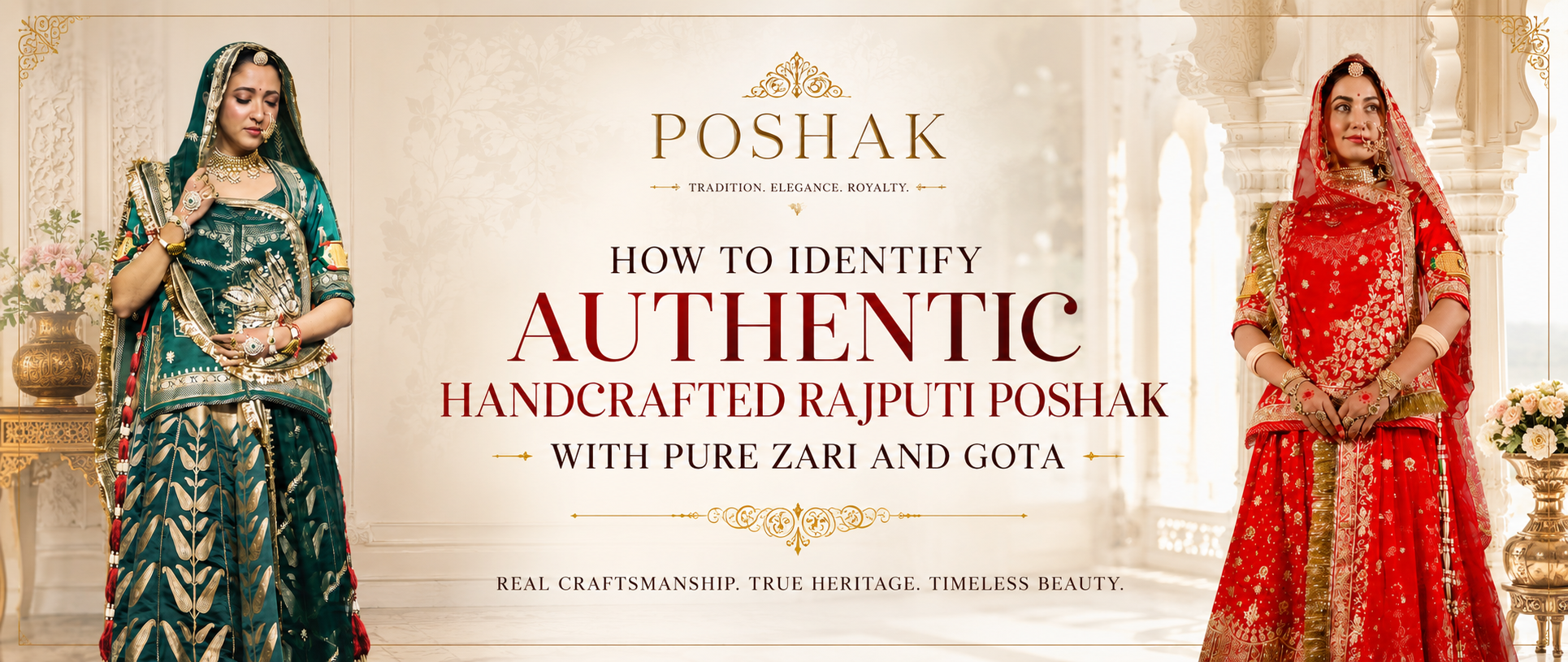
Traditional Vintage Rajputi Poshak Inspired by Royal Rajasthan
Walk into any old haveli in Rajasthan and look at the paintings on the walls. The women in those murals -the way they are dressed, the way the fabric falls, the embroidery catching the light -that is exactly what a vintage Rajputi poshak brings back.
There is a reason women keep coming back to this aesthetic. Modern fashion moves fast and forgets itself quickly. But the vintage Rajputi look has stayed relevant for hundreds of years because it was never really about trends. It was about identity, craftsmanship, and a way of carrying yourself that no fast fashion piece can replicate.
If you have been thinking about adding a vintage Rajputi poshak to your wardrobe -for a function, a wedding, or just because you love the aesthetic -this guide covers everything you need to know.
What Makes a Poshak "Vintage" in the Rajputi Sense
The word vintage gets used loosely in fashion. But when it comes to a vintage Rajputi poshak, it has a very specific meaning.
It refers to a style that draws directly from the courts and havelis of old Rajasthan. The design elements come from a time when every stitch was done by hand, every motif carried meaning, and the fabric was chosen to last decades, not seasons.
A genuine vintage-inspired Rajputi poshak typically has:
- Deep, earthy or jewel-toned colours -ochre, rani pink, indigo, olive, amber
- Handwork embroidery using techniques like Aari, Dabka, Tari, Salma, and Sequin work
- Heavy borders on the ghagra with detailed motifs
- A kanchli cut that follows the traditional silhouette -fitted, structured, regal
- An odhni with embroidered edges rather than plain fabric
The overall effect is one of quiet grandeur. Nothing is trying too hard. Everything just looks like it belongs together.
The Colours That Define the Vintage Rajputi Look
Colour is the first thing that sets a vintage Rajputi poshak apart from a regular ethnic outfit.
The vintage palette avoids the overly bright and synthetic shades of modern fast fashion.
Instead, it leans into colours that feel aged, rich, and deeply rooted:
- Rani pink- a warm, deep pink that has been central to Rajputi bridal and festive dressing for generations
- Olive and earthy greens- muted and sophisticated, these shades photograph beautifully in natural light
- Indigo and deep blue- a colour that appears extensively in Rajasthani art and architecture, carries enormous visual weight
- Bamber and amber tones- warm golden yellows that look stunning against most skin tones
- Ivory and off-white- used often in vintage-style poshaks for a softer, more antique feel
What ties these colours together is that they all age well. They look as rich in photographs taken ten years from now as they do today.
Embroidery That Carries the Royal Heritage
A vintage Rajputi poshak without serious embroidery is just a coloured outfit. The embroidery is what actually connects it to its royal Rajasthani origins.
The techniques used in vintage-style Rajputi embroidery are not shortcuts. They take real skill and real time:
- Aari work- a hook-needle technique that creates incredibly detailed floral and paisley patterns, very traditional to Rajasthan
- Dabka and Tari work- thick metal wire and flat metallic threads used together to build raised, dimensional embroidery
- Salma work- twisted metal wire stitched into intricate patterns, gives the surface a layered texture
- Sequin work- not the cheap plastic kind, but the heavier metallic sequins that sit flat and catch light the way vintage brocade does
- Zari and Resham combined- the contrast between metallic gold thread and coloured silk thread creates the layered richness you see in old Rajputi textiles
When these techniques are done well, the embroidery becomes the story of the outfit. Each panel looks like it was painted rather than stitched.
Four Vintage Rajputi Poshaks Worth Wearing
Here are four options that genuinely carry the vintage Rajputi aesthetic -well-made, traditionally inspired, and suitable for everything from weddings to big family functions.
1. Rajputi Poshak- Rani Satin Aari Salma Sequins Heavy Handwork Rani pink with Aari, Salma, and sequin handwork -this one is as close to a vintage royal poshak as readymade comes. The combination of techniques gives the embroidery real depth, and the rani shade sits in that perfect space between festive and traditional. View this poshak here
2. Rajputi Poshak- Rani Bamber Satin Aari Sequins Handwork with Odhna: This one comes with a matching odhna, which makes the whole look complete without any searching for a separate dupatta. The bamber-rani combination is unusual and genuinely striking -warm and rich in a way that most single-colour poshaks are not. View this poshak here
3. Aari Salma Sequence Blue Poshak- Deep blue is one of those colours that looks timeless in Rajputi wear. This poshak uses Aari, Salma, and sequin work on a blue base that immediately reads as vintage and royal. For anyone who wants to move away from the usual reds and pinks, this is the most confident alternative. View this poshak here
4. Rajputi Poshak- Olive Satin Dabka Tari Handwork with Odhna: Olive is not a colour you see often in Rajputi wear, which is exactly what makes this one interesting. The Dabka and Tari handwork on an olive satin base looks like something lifted directly from a haveli painting. For functions in natural light -outdoor weddings, day functions -this poshak photographs unlike anything else. View this poshak here
How to Style a Vintage Rajputi Poshak
The vintage aesthetic works best when the styling supports the outfit rather than competing with it.
A few things that always work:
- Antique gold jewellery over bright polished gold -the aged finish matches the vintage feel perfectly
- Kundan or Meenakari pieces with deep coloured stones rather than plain diamond-style sets
- Oxidised silver accessories work especially well with the olive and blue poshak options
- Fresh flowers or dried flower accessories in the hair instead of heavy tikkas for a more relaxed vintage look
- Embroidered juttis that pick up a colour from the poshak -keeps the look cohesive without being too matchy
For makeup, a warm eye look with a deep nude or terracotta lip suits the vintage palette better than a bold red lip. The idea is warmth and depth rather than brightness.
The Bottom Line
A vintage Rajputi poshak is not something you buy because it is trending. You buy it because it connects you to something real -a craft tradition, a cultural identity, a way of dressing that has survived centuries because it was genuinely beautiful to begin with.
Whether you are wearing it to a wedding, a function, or just want something in your wardrobe that has actual heritage behind it, the vintage Rajputi poshak delivers in a way that most modern ethnic wear simply cannot.
Frequently Asked Questions
Q1. Is a vintage Rajputi poshak suitable for young women or is it for older generations?
It works across every age group. The vintage silhouette and embroidery actually look very striking on younger women -it is not an old-fashioned look at all.
Q2. Can I wear a vintage Rajputi poshak to a modern wedding venue?
Absolutely. A beautifully made poshak stands out at any venue -traditional or contemporary. The outfit carries its own atmosphere with it.
Q3. How do I identify genuine handwork embroidery on a poshak?
Flip the fabric and look at the back. Real handwork has visible thread ends and slight irregularities on the reverse side. Machine embroidery looks perfectly uniform on both sides.
Q4. What footwear works best with this style?
Embroidered mojaris or juttis are the most natural pairing. Choose a colour that picks up one shade from the poshak for a pulled-together look.
Q5. Are these poshaks comfortable for full-day functions?
Satin silk base fabrics are quite comfortable for long wear. The weight sits mainly in the embroidery, which is concentrated on the kanchli and borders rather than the full ghagra.
Be part of Yuvti on Facebook & Instagram for next-level Rajputi bridal looks and exclusive reveals.